
Singapore Bylaws Template
Singapore bylaws template for VFX cooperative governance, membership rules, meetings, and administration.
Bylaws template for
Singapore nonprofit VFX cooperative formation
2023 September 21: Proposed
ARTICLE I: OBJECTIVES
Non-Profit Cooperative
VFX Cooperative (“the Cooperative”) is constituted as a non-profit cooperative. Its objective is not profit accrual for itself or its members but to operate for the mutual benefit of its members, herein referred to as patrons, including workers and users availing the cooperative’s services.
Mission
The mission of the Cooperative is to foster enduring, mutually beneficial relationships with clients, establish a sustainable, economically equitable workplace for members, and empower creative professionals through democratic ownership, sortition, and technology.
Guiding Principles
Open and Voluntary Membership: Membership is open and voluntary to all who can fulfill the employment needs and are willing to accept membership responsibilities, irrespective of race, religion, gender, or economic conditions.
Democratic Member Control: Adherence to the “one worker, one vote” principle is mandatory. Members actively participate in policy formulation and decision-making, ensuring democratic control and member accountability.
Sovereignty of Labor: The Cooperative values labor, committing to wealth distribution based on labor and job creation. Worker-owners receive equitable salaries and dividends aligned with cooperative profitability.
Participation in Management: Worker-owners participate in management roles and board membership, ensuring organizational accountability.
Autonomy and Independence: Any agreements or capital raisings uphold the Cooperative’s autonomy, democratic control, and unique identity.
Inter-Cooperative Collaboration: The Cooperative collaborates with other cooperatives, sharing resources like financing and research to foster mutual support.
Education and Training Value: The Cooperative promotes continuous, relevant education and fosters an understanding of cooperative benefits and nature.
ARTICLE II: DEFINITIONS
Terms Defined
Member: A qualified and accepted individual holding an equity interest in the Cooperative, including Patron and Preferred Members.
Patron Member: A Cooperative member designated as a patron.
Preferred Member: A non-patron member with an equity interest, serving as an equity investor.
Person: Includes individuals, partnerships, corporations, cooperatives, and other entities.
Candidate: An individual under consideration for Patron membership.
ARTICLE III: MEMBERSHIP
Classification
The Cooperative has two member classes
Patron Members
Preferred Members
Patron Members
Sub-classes of Patron Members, including Worker-owners, may be established through board majority vote.
Worker-owners
Qualifications: Natural persons employed by the Cooperative, approved for membership, and have paid the membership fee.
Admission Procedure: Interested employees may submit a written request, followed by a special meeting of Worker-owners to vote on the admission.
Provisional Status: Admitted individuals attain provisional status until half of the membership fee is paid, post which, they attain full rights and privileges.
Resignation and Termination: Worker-owners may resign, and membership may be terminated, with each action adhering to notice, hearing, and liability conditions detailed herein.
Founding Members
Founding Members, a sub-class of Worker-owners, retain similar rights with optional board seat retention as detailed in Article V, Section B.
Preferred Members
Preferred Members possess no voting rights but are entitled to preferred distributions and liquidation preferences as described in Article VIII.
ARTICLE IV: MEMBERSHIP DIAGRAM
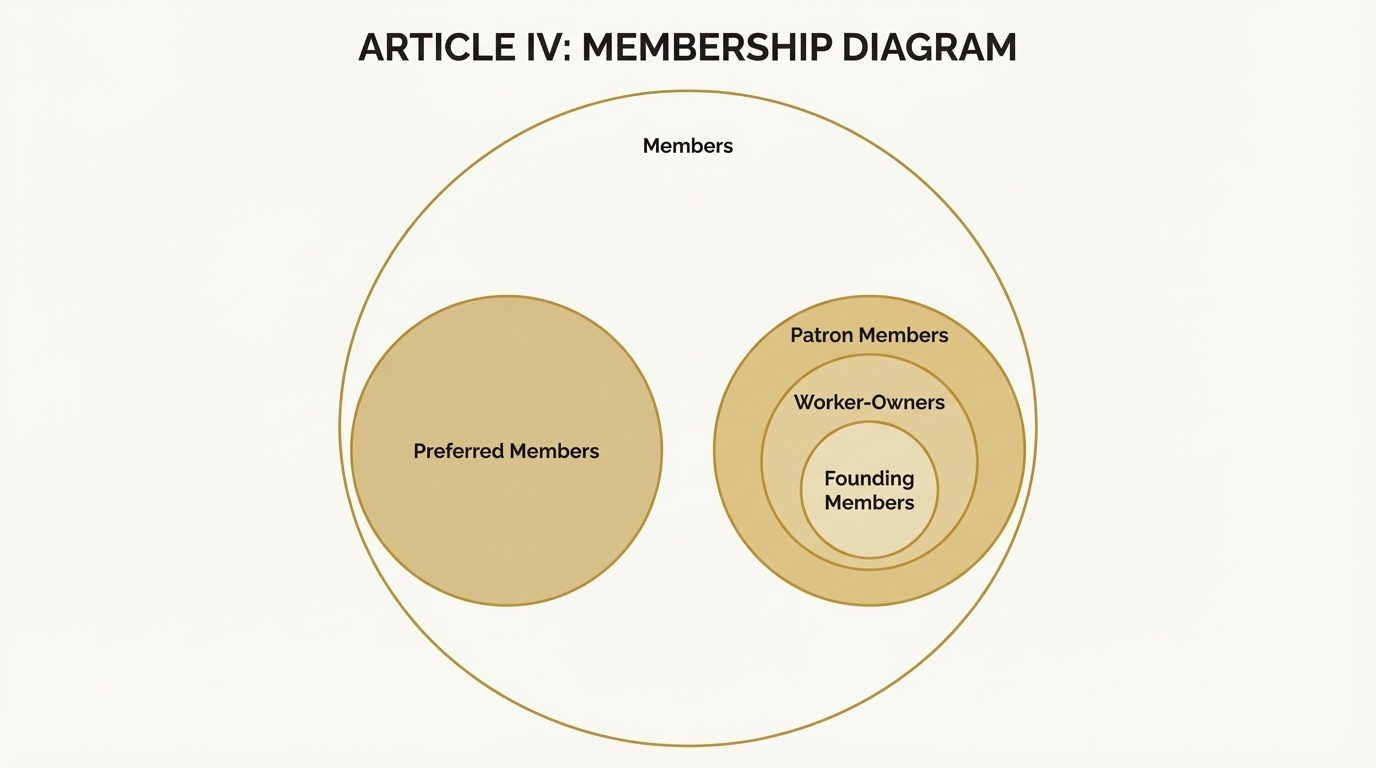
ARTICLE IV: MEMBER MEETINGS AND VOTING
A. Member Voting
All Worker-owners shall possess equal voting power. Preferred Members shall be excluded from exercising any voting rights. Upon creation of new sub-classes of Patron Members by the Board, the Board will allocate voting rights to such sub-classes accordingly.
Members barred from voting on certain matters shall not be considered in establishing a quorum or in calculating the requisite vote to sanction action on those matters.
Decisions by the Membership will be determined by the affirmative vote of a majority of the Members with voting rights present at a properly convened meeting with a quorum.
Voting by proxy and cumulative voting are expressly prohibited.
Members are entitled to fair nomination and election procedures for directors, reflecting the cooperative's nature, size, and operations.
B. Meetings
The cooperative shall convene an annual meeting. The Board may also convene special meetings. Meetings can be conducted serially and in multiple locations.
Twenty percent of eligible voting members can compel a special meeting by presenting a petition outlining the specific agenda and demanding such a meeting. Compliance results in the Board convening the meeting.
Director elections occur at annual meetings.
C. Electronic Participation
Subject to Board approval and member consent, members can attend, participate, and vote in meetings electronically, provided there are adequate measures ensuring reasonable participation and voting opportunities, concurrent access to proceedings, and maintenance of electronic participation records by the cooperative.
D. Notice
Each eligible voting member must receive at least a ten-day prior notice, detailing the meeting’s purpose, either personally, by mail, or electronically. Compliance for mailed notices is achieved upon postage-prepaid deposit, and electronic notices upon receipt of delivery confirmation by the cooperative.
E. Waiver of Notice
A signed waiver equates to personal notice, and can be signed anytime.
F. Quorum
A majority of the members with voting rights forms a quorum at member meetings.
G. Action Without a Meeting
Actions requiring member authorization can be sanctioned without a meeting with sixty per cent affirmative votes of eligible voting members. Such actions must be recorded as per meeting minutes.
H. Record Date
The Board can predetermine a record date, not exceeding 60 days before the meeting, to ascertain eligible voting members. If not fixed, eligibility is determined on the meeting day.
ARTICLE V: DIRECTORS
A. Powers
Unless specified otherwise, the Board exercises or directs all cooperative authority.
B. Composition and Qualifications
The Board of Directors shall be composed of a minimum of five directors, who are to be elected by the voting Patron Members. However, if the total number of Patron Members is fewer than five, the number of directors may be equivalent to the number of Patron Members. It is imperative that all directors maintain their membership in good standing within the cooperative. As long as there exists one or more Preferred Members within the cooperative, one director must be elected from the Preferred Members.
For Worker-owner members aspiring to be nominated to the board, the following eligibility criteria must be met:
The individual must have held the status of a worker-owner member for a minimum duration of one year preceding the election date.
The individual must be a fully engaged and active worker-owner member, with active status being characterized by a contribution of a minimum of 500 work hours in the six months leading up to the nomination.
A minimum of two directors should be individuals who are Founding Members of the cooperative, except under the following circumstances:
If no Founding Member is willing to serve as a director;
If willing Founding Members are precluded by the term limits delineated in Section C of this Article;
If there are no Founding Members remaining within the cooperative.
The precise number of directors shall be determined and fixed through a resolution passed by the existing directors.
C. Terms of Office
Directors serve alternating two-year terms, with re-election restrictions post two consecutive terms. A vacancy-filled director serves until the original term expires.
D. Voting
Each director has one vote per matter, and proxy voting is prohibited. A majority vote of present directors at a duly convened meeting affects Board decisions.
E. Notice of Board Meetings
Regular and special meetings are conducted as per Board specifications, with notices dispatched adequately.
F. Waiver of Notice
Waivers of notice or attendance without protest validate meeting notifications.
G. Electronic Participation
Directors may attend meetings electronically, under specific conditions ensuring comprehensive and concurrent communication.
H. Quorum
A majority of the existing directors forms a quorum, with continuation provisions post director withdrawal.
I. Adjournment
Any majority, irrespective of quorum, can adjourn meetings with mandatory notice for prolonged adjournments.
J. Action Without a Meeting
Unanimous written consent facilitates Board or committee actions without meetings, and such actions are recorded as regular minutes.
K. Vacancies
The remaining directors fill vacancies by majority vote.
L. Resignation
Directors can resign by submitting written notice to specified cooperative representatives.
M. Removal
Members can instigate director removal procedures by presenting written charges and a supporting petition, leading to a removal vote at the subsequent member meeting.
ARTICLE VI: COMMITTEES
The Board may establish committees by resolution, with specific member composition and authority limits. Committees exercising Board authority must exclusively consist of directors. Non-Board authority committees can include non-directors.
ARTICLE VII: OFFICERS
A. Composition of Officers
The officers of the cooperative shall comprise a President, a Secretary, and a Treasurer. If deemed necessary, the cooperative may also appoint a Chairperson, one or more Vice Chairpersons of the Board, one or more Vice-Presidents, and such other officers and assistant officers as may be deemed appropriate. The Chairperson and any Vice Chairperson of the Board must be directors. However, other officers are not required to be directors. An individual may hold two or more offices concurrently, but no officer shall authenticate any instrument in more than one capacity if the instrument is mandated by law, the Articles, or the Bylaws to be authenticated by two or more officers.
B. Election and Removal of Officers
Officers shall be elected annually by the Board to serve one-year terms. They may be removed by a vote of the Board. Any member may level charges against an officer by submitting them in writing to the Secretary, accompanied by a petition signed by twenty percent of the members, calling for the removal of the officer in question. The officer's removal shall be decided at the subsequent regular or special meeting of the members and may be executed by a majority vote of the members eligible to vote. The accused officer shall be notified in writing of the charges before the meeting and shall have the right to be heard, either in person or by counsel, and to present witnesses. The individuals bringing the charges shall be afforded the same opportunity.
C. Resignation
Officers may resign at any time by providing written notice to the cooperative. Such resignation shall not impair the rights, if any, of the cooperative under any contract to which the resigning officer is a party.
D. Vacancy
Vacancies occurring in any office due to death, resignation, removal, disqualification, or any other cause shall be filled by the Board unless otherwise stipulated herein.
E. Duties of President
The President shall preside at all meetings of the Board and members and shall undertake such other powers and duties as may be assigned by the Board of Directors periodically.
F. Duties of Secretary
The Secretary shall maintain, or ensure the maintenance of, a minute book recording all meetings and actions of the members, the Board of Directors, and Board committees at the principal executive office or another location as designated by the Board of Directors. Additionally, the Secretary shall maintain the cooperative's requisite records as outlined in Article XI. The Secretary shall issue or ensure the issuance of notices for all required meetings of the members, the Board, and Board committees, as mandated by statute or by these Bylaws. Should the Secretary or their designate fail to do so, any other officer of the cooperative may issue such notices. The Secretary shall also undertake such other duties as prescribed by the Board of Directors or by these Bylaws.
G. Duties of Chief Financial Officer
The Chief Financial Officer shall maintain or ensure the maintenance of accurate and appropriate books and records of the cooperative’s properties and transactions, including its assets, liabilities, receipts, disbursements, gains, losses, capital, retained earnings, and memberships. Specifically, the Chief Financial Officer shall:
Deposit all funds and valuables in the name and to the credit of the cooperative with depositories as designated by the Board of Directors;
Disburse the cooperative’s funds as authorized by the Board;
Provide a detailed account of the financial condition of the cooperative and all transactions undertaken as Chief Financial Officer upon request by the President or the Board of Directors;
Perform such other duties and have such other powers as prescribed by the Board of Directors or by these Bylaws.
The Chief Financial Officer shall present a quarterly report detailing the overall financial condition of the cooperative. For the purpose of presenting reports or executing certificates or other documents, the Chief Financial Officer shall be considered the Treasurer.
ARTICLE VIII: ALLOCATIONS AND DISTRIBUTIONS
A. Fiscal Year
The fiscal year of the Cooperative concludes on the final day of June annually.
B. Definitions
Distributable: Cash Refers to the net cash at the fiscal year’s end, minus current expenses and reasonable reserves for future expenses, as decided by the Board of Directors, and legally permissible to distribute.
Patronage: Is measured using methods deemed reasonable by the Board at its discretion.
Patronage Dividends: Are allocated among members based on each member’s proportion of patronage. This allocation may vary for sub-classes of Patron Members, only to be distributed to the Patron Member class.
Distribution: Refers exclusively to the distribution of dividends, excluding Patronage Dividends.
Member Account: Is the individual capital account of each member within the Cooperative.
Collective Account: Comprises reserves retained within the Cooperative and unallocated to members.
C. Allocations and Distributions
Post each fiscal year, the Cooperative determines the Distributable Cash and relative Patronage. Following this determination, the Board shall:
Declare and pay Distribution to Preferred Members based on the availability of Distributable Cash.
Distribute the remaining Distributable Cash to members and other eligible patrons on the basis of patronage.
D. Patronage Dividends
These dividends may be paid in various forms, as decided by the Board, with at least 20% being distributed in cash.
E. Tax Obligations
Members shall declare any received Patronage Dividends on their income tax return in accordance with applicable laws.
F. Redemption of Preferred Memberships
Preferred Memberships can be redeemed by the Cooperative or upon request by a Preferred Member, subject to conditions and restrictions, post the fifth anniversary of investment.
G. Settlement Upon Termination
Upon a member’s termination, the Cooperative shall settle the Member Account by repaying the amount in the account within five years with accruing interest, subject to set-offs for any indebtedness of the former member to the Cooperative.
H. Periodic Redemption of Patron Member Accounts
The Cooperative aims to settle all funds credited to Member Accounts within five years of crediting, subject to the availability of funds and Board’s discretion.
I. Distributions Upon Liquidation or Sale
In such events, proceeds are allocated to settle indebtedness, Preferred Members’ capital account balances, Patron Members’ capital account balances, and remaining proceeds are distributed among current and former Patron Members.
J. Limitations
The Cooperative shall not undertake any financial actions that could impair its ability to meet its matured liabilities.
K. Unclaimed Equity Interests
Unclaimed equity interests and dividends can be forfeited to the Cooperative after bona fide attempts to contact the owner fail.
ARTICLE IX: CHECKS AND CONTRACTS
A. Authorized Signatories for Checks
All financial instruments issued in the name of the Cooperative will be signed or endorsed by persons authorized by the Board.
B. Executing Corporate Contracts and Instruments
Officers, agents, or employees acting on behalf of the Cooperative must have the necessary authority granted by the Board to bind the Cooperative in any manner.
ARTICLE X: TRANSFER OF MEMBERSHIPS
Patron Members may not transfer their membership or any rights derived therefrom. All rights cease upon the member’s death or termination of employment. Preferred Membership may only be transferred in accordance with the law.
ARTICLE XI: RECORDS
A. Maintenance of Records
The cooperative shall meticulously maintain accurate and comprehensive books and records of account, in addition to the minutes of the proceedings from the meetings of its members and board. It shall preserve, at its principal office, detailed records documenting the names and addresses of all members along with the extent of ownership interests held by each member.
B. Inspection Rights
Members may, at any reasonable time, inspect the cooperative’s books and records, provided they supply written notice stating a proper purpose for the examination at least one week in advance. This notice must be either delivered or sent to the cooperative. The inspection will be confined to those records pertinent to the stated purpose in the notice. The board retains the right to refuse a member's request if the purpose is deemed improper, i.e., not directly related to the person's interests as a member and is contrary to the cooperative’s best interests.
ARTICLE XII: INDEMNIFICATION
The cooperative is authorized to indemnify its officers, directors, employees, and agents to the fullest extent permissible under law.
ARTICLE XIII: BYLAW AMENDMENT
The board, with a two-thirds majority vote, has the authority to adopt or amend the bylaws or any specific bylaw. Any bylaw thus adopted or amended must be reported at the subsequent member meeting and is subject to further amendment or repeal by the members at any time.
Any bylaw may be instituted, modified, or rescinded by a majority of the member votes cast on the proposal.
ARTICLE XIV: AMENDMENT OF THE ARTICLES OF INCORPORATION
The articles of incorporation may be modified or amended at any regular or special meeting convened for that purpose, subject to the inclusion of the proposed change text, or a general description thereof, in the meeting notice.
Any amendment must first secure approval from two-thirds of the directors, followed by adoption through an affirmative vote of sixty per cent of the member votes cast on the amendment.
ARTICLE XV: OPERATING POLICIES
The board is tasked with adopting operating policies encompassing current membership fees and any other rules or policies deemed in the cooperative’s best interest. Such policies are subject to amendment by a majority vote of the board and must be kept current and accessible to all cooperative members. These policies shall be obligatory for all members unless they are in conflict with the articles of incorporation, these bylaws, or any prevailing law.